43 indexing using labels in dataframe
MultiIndex / advanced indexing — pandas 1.4.2 documentation You can provide any of the selectors as if you are indexing by label, see Selection by Label , including slices, lists of labels, labels, and boolean indexers. You can use slice (None) to select all the contents of that level. You do not need to specify all the deeper levels, they will be implied as slice (None). Select Data From Pandas Dataframes - Earth Data Science Select Data Using Columns. In addition to location-based and label-based indexing, you can also select data from pandas dataframes by selecting entire columns using the column names. For example, you can select all data from a specific column in a pandas dataframe using: dataframe ["column"]
Python | Pandas DataFrame - GeeksforGeeks 10.01.2019 · Pandas DataFrame is two-dimensional size-mutable, potentially heterogeneous tabular data structure with labeled axes (rows and columns). A Data frame is a two-dimensional data structure, i.e., data is aligned in a tabular fashion in rows and columns. Pandas DataFrame consists of three principal components, the data, rows, and columns.. We will get a brief insight …
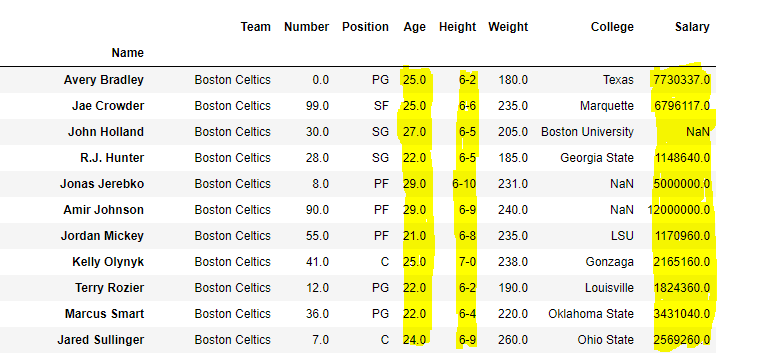
Indexing using labels in dataframe
Indexing, Slicing and Subsetting DataFrames in Python Indexing by labels loc differs from indexing by integers iloc. With loc, both the start bound and the stop bound are inclusive. When using loc, integers can be used, but the integers refer to the index label and not the position. For example, using loc and select 1:4 will get a different result than using iloc to select rows 1:4. How to find index of value in Pandas dataframe - DevEnum.com 2. df.index.values to Find index of specific Value. To find the indexes of the specific value that match the given condition in Pandas dataframe we will use df ['Subject'] to match the given values and index. values to find an index of matched value. The result shows us that rows 0,1,2 have the value 'Math' in the Subject column. pandas Tutorial => Select distinct rows across dataframe Indexing and selecting data; Boolean indexing; Filter out rows with missing data (NaN, None, NaT) Filtering / selecting rows using `.query()` method; Filtering columns (selecting "interesting", dropping unneeded, using RegEx, etc.) Get the first/last n rows of a dataframe; Mixed position and label based selection; Path Dependent Slicing; Select ...
Indexing using labels in dataframe. Pandas Set Column as Index in DataFrame - Spark by {Examples} Use DataFrame.set_index() method to set the existing column of DataFrame as an index. On DataFrame, the row label is an Index. If your DataFrame has already had an Index, this replaces the existing index or expands on it. You can set the DataFrame index (row labels) using one or more existing columns or arrays (of the correct length). Syntax: Indexing and Selecting Data with Pandas - GeeksforGeeks Indexing a DataFrame using .loc [ ] : This function selects data by the label of the rows and columns. The df.loc indexer selects data in a different way than just the indexing operator. It can select subsets of rows or columns. It can also simultaneously select subsets of rows and columns. Selecting a single row Python Pandas - Indexing and Selecting Data - Tutorials Point Pandas provide various methods to have purely label based indexing. When slicing, the start bound is also included. Integers are valid labels, but they refer to the label and not the position. .loc () has multiple access methods like − A single scalar label A list of labels A slice object A Boolean array Indexing and selecting data — pandas 1.4.2 documentation pandas provides a suite of methods in order to have purely label based indexing. This is a strict inclusion based protocol. Every label asked for must be in the index, or a KeyError will be raised. When slicing, both the start bound AND the stop bound are included, if present in the index.
Pandas DataFrame Indexing - KDnuggets In pandas data frames, each row also has a name. By default, this label is just the row number. However, you can set one of your columns to be the index of your DataFrame, which means that its values will be used as row labels. We set the column 'name' as our index. It is a common operation to pick out one of the DataFrame's columns to work on. How to Index Data in Pandas with Python - Medium One way we can specify which rows and/or columns we want is by using labels. For rows, the label is the index value of that row, and for columns, the column name is the label. For example, in our ufo dataframe, if we want the fifth row only along with all the columns, we would use the following: ufo.loc [4, :] single label. Tutorial: How to Index DataFrames in Pandas - Dataquest Let's explore four methods of label-based dataframe indexing: using the indexing operator [], attribute operator ., loc indexer, and at indexer. Using the Indexing Operator If we need to select all data from one or multiple columns of a pandas dataframe, we can simply use the indexing operator []. How to Subset a DataFrame in Python? - AskPython This line of code selects rows from 1 to 7 and columns corresponding to the labels ‘population’ and ‘housing’. Subset a Dataframe using Python iloc() iloc() function is short for integer location. It works entirely on integer indexing for both rows and columns. To select a subset of rows and columns using iloc() use the following line ...
Python Pandas: Get Index Label for a Value in a DataFrame If I know the value in 'hair' is 'blonde', how do I get the index label (not integer location) corresponding to df.ix['mary','hair']? (In other words, I want to get 'mary' knowing that hair is 'blonde'). If I wanted the integer value of the index I'd use get_loc. But I want the label. Thanks in advance. Indexing in Pandas Dataframe using Python - Medium Indexing using .loc method. If we use the .loc method, we have to pass the data using its Label name. Single Row To display a single row from the dataframe, we will mention the row's index name in the .loc method. The whole row information will display like this, Single Row information Multiple Rows How to Select Rows by Index in a Pandas DataFrame - Statology .iloc selects rows based on an integer index. So, if you want to select the 5th row in a DataFrame, you would use df.iloc [ [4]] since the first row is at index 0, the second row is at index 1, and so on. .loc selects rows based on a labeled index. So, if you want to select the row with an index label of 5, you would directly use df.loc [ [5]]. Pandas filter(): Select Columns and Rows by Labels in a Dataframe It primarily use labels of dataframe to subset a dataframe. Here we will see examples of how to is Pandas filter() function to select one or more columns using the column names and select one or more rows using row indices. ... Our toy dataframe' row index is integer. For the sake of easiness, let us change the row index to be string instead ...
Indexing and Selecting Data with Pandas - GeeksforGeeks
Pandas Indexing Examples: Accessing and Setting Values on DataFrames Source dataframe select row whose index label is 0 select rows whose index labels are 2 and 3 loc example, string index Use .loc [] to select rows based on their string labels:
Issue: Part Labels Display Incorrect Barcode Data when Processing to Multiple Machines in 15.6
Pandas : Sort a DataFrame based on column names or row index labels ... In the Python Pandas Library, the Dataframe section provides a member sort sort_index () to edit DataFrame based on label names next to the axis i.e. DataFrame.sort_index (axis=0, level=None, ascending=True, inplace=False, kind='quicksort', na_position='last', sort_remaining=True, by=None) Where,
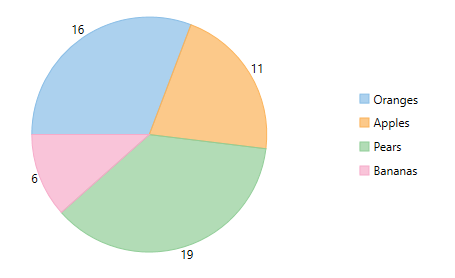
Formatting Data Labels | FlexChart for WPF | ComponentOne
Delete column/row from a Pandas dataframe using .drop() method 02.02.2020 · While working with data in Pandas, you might want to drop a column(s) or some rows from a pandas dataframe. One typically deletes columns/rows, if they are not needed for further analysis. There are a couple of ways you can achieve this, but the best way to do this in Pandas is to use .drop() method. .drop() The .drop() function allows you to delete/drop/remove …

XML/JSON Attributes for Data Labels
MultiIndex / advanced indexing — pandas 1.4.2 documentation A MultiIndex can be created from a list of arrays (using MultiIndex.from_arrays()), an array of tuples (using MultiIndex.from_tuples()), a crossed set of iterables (using MultiIndex.from_product()), or a DataFrame (using MultiIndex.from_frame()). The Index constructor will attempt to return a MultiIndex when it is passed a list of tuples. The ...

ProgrammingHunk: Pandas DataFrame Introduction
Selecting, Slicing and Filtering data in a Pandas DataFrame Posted on 16th October 2019. One of the essential features that a data analysis tool must provide users for working with large data-sets is the ability to select, slice, and filter data easily. Pandas provide this feature through the use of DataFrames. A data frame consists of data, which is arranged in rows and columns, and row and column labels.
Issue: Part Labels Display Incorrect Barcode Data when Processing to Multiple Machines in 15.6
Pandas: Create an index labels by using 64-bit integers, floating-point ... Have another way to solve this solution? Contribute your code (and comments) through Disqus. Previous: Write a Pandas program to display the default index and set a column as an Index in a given dataframe and then reset the index. Next: Write a Pandas program to create a DataFrame using intervals as an index.

The Pandas DataFrame – loading, editing, and viewing data in Python - BLOCKGENI
Set Index in pandas DataFrame - PYnative We need to pass the column or list of column labels as input to the DataFrame.set_index () function to set it as an index of DataFrame. By default, these new index columns are deleted from the DataFrame. df = df.set_index ( ['col_label1', 'col_label2'…]) Set the index in place. We can use the parameter inplace to set the index in the existing ...
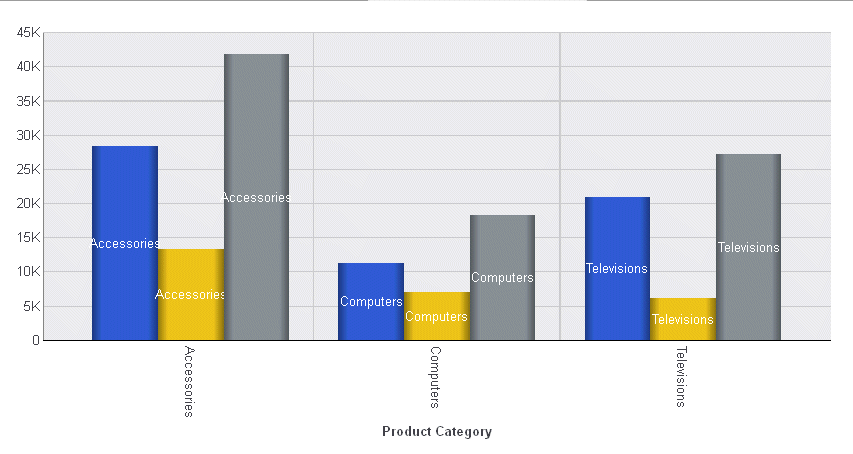
Showing and Formatting Data Text Labels for All Series
How to get the names (titles or labels) of a pandas data frame in python To get the names of the data frame rows: >>> df.index Index(['Alice', 'Bob', 'Emma'], dtype='object') Get the row names of a pandas data frame (Exemple 2) Another example using the csv file train.csv (that can be downloaded on kaggle): >>> import pandas as pd >>> df = pd.read_csv('train.csv') >>> df.index RangeIndex(start=0, stop=1460, step=1)
Pandas Isin Examples Dataframe
The Pandas DataFrame: Make Working With Data Delightful The Pandas DataFrame is a structure that contains two-dimensional data and its corresponding labels.DataFrames are widely used in data science, machine learning, scientific computing, and many other data-intensive fields.. DataFrames are similar to SQL tables or the spreadsheets that you work with in Excel or Calc. In many cases, DataFrames are faster, easier to use, and more …

Understanding Data Labels and User Labels
Working With Specific Values In Pandas DataFrame - Data Courses This function of a pandas DataFrame is of high value as you can build an index using a specific column, (meaning: a label) that you want to use for managing and querying your data. For example, one can develop an index from a column of values and then use the attribute.loc to select data from pandas DataFrame based on a value found in the index.

Pandas .loc indexing based on index labels – Shane Lynn
Boolean Indexing in Pandas - Tutorials Point Now, we can pass the boolean vector to the DataFrame to access the data. Example # passing boolean vector to data_frame index print(data_frame[ [True, True, False]]) Output If run the above code, you will get the following results. We got the row only that is True. Name Age 0 Hafeez 19 1 Srikanth 20 Conclusion
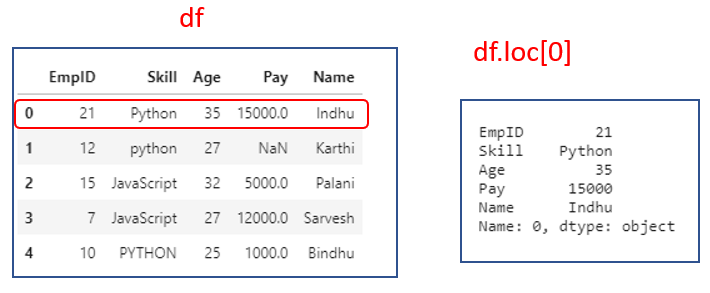
Indexing and Slicing Python Pandas DataFrame | by Indhumathy Chelliah | Towards AI
Indexing a Pandas DataFrame for people who don't like to remember things In pandas data frames, each row also has a name. By default, this label is just the row number. However, you can set one of your columns to be the index of your DataFrame, which means that its values will be used as row labels. We set the column 'name' as our index. It is a common operation to pick out one of the DataFrame's columns to work on.
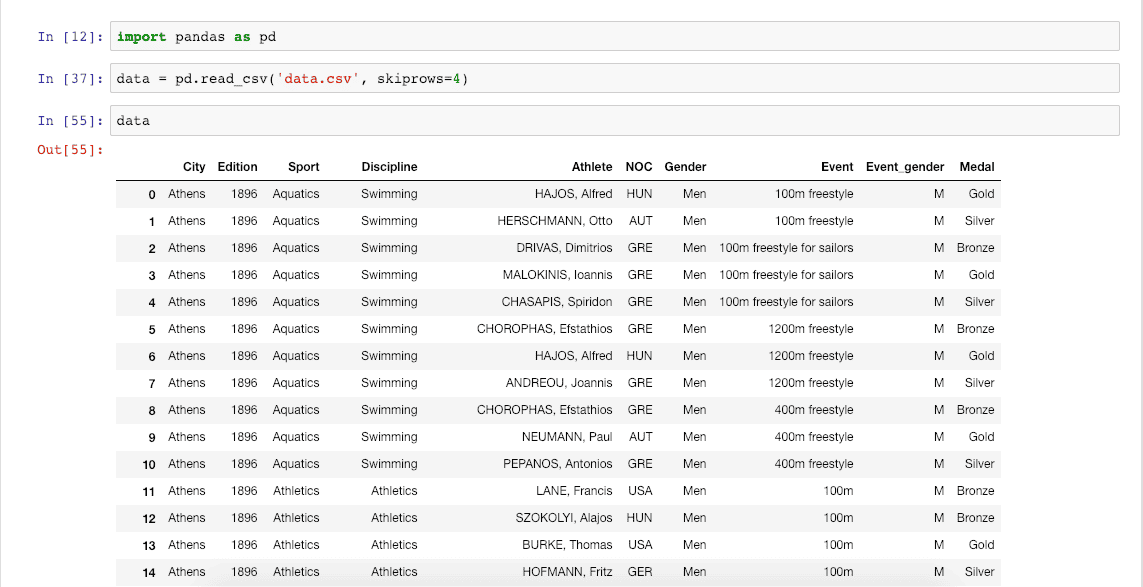
33 The Label Is Not In The Index Pandas - Labels Design Ideas 2021
Indexing and Sorting a dataframe using iloc and loc Labels based indexing using loc. To index a dataframe based on column names, loc can be used. For example, to get all the columns between petal_length till iris class and records from 2nd to 10th, can be extracted by using - ... Simples way to sort a dataframe can be done using sort_values function of pandas dataframe, which take the column ...
Labels | Datafile
Pandas DataFrame Indexing: Set the Index of a Pandas Dataframe Python list as the index of the DataFrame In this method, we can set the index of the Pandas DataFrame object using the pd.Index (), range (), and set_index () function. First, we will create a Python sequence of numbers using the range () function then pass it to the pd.Index () function which returns the DataFrame index object.
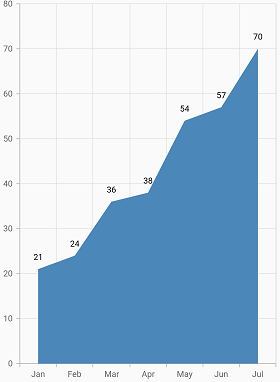
Markers and data labels in Syncfusion Flutter Charts
Label-based indexing to the Pandas DataFrame - GeeksforGeeks Indexing plays an important role in data frames. Sometimes we need to give a label-based "fancy indexing" to the Pandas Data frame. For this, we have a function in pandas known as pandas.DataFrame.lookup (). The concept of Fancy Indexing is simple which means, we have to pass an array of indices to access multiple array elements at once.

Format of IBM standard data set label 1 (HDR1/EOV1/EOF1)
Pandas DataFrame drop: How to Drop Rows and Columns 01.06.2020 · ‘English’ Finally, row_labels refers to the list that contains the labels of the rows, which are numbers ranging from a to e. Pandas DataFrames can sometimes be very large, making it impractical to look at all the rows at once. Instead, you can use the .head() to show the first few items and tail() to show the last few items.. Now, let’s understand the syntax of the …
Post a Comment for "43 indexing using labels in dataframe"